Wild Poppies, daisies and buttercup meadows. Wherever you look, here on Anglesey, the flowers are all blooming. Here comes summer! Let's hope it's a hot one.


 Here are some recent images taken within a fifteen minute stroll along the clifftops between Trearddur Bay and Porth y Post. This is what I love about this place, wherever you look there will be a picture to be taken, a picture to be made. This is my back garden, my backyard, my home.
 How many lives has this lifebelt saved? How many times has it been thrown in vain. Like a solider on guard, it stands to attention, ready and waiting to serve and to save. day after day, night after night it waits and waits and waits...
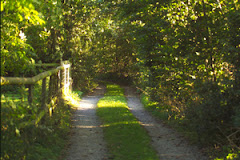
 My favourite path, but to where?
 Anglesey has one of the most successful race circuits in the UK. Having just spent a large amount of money on expanding its circuit to over 2 miles in length, it is now atracting race competitions from all over the country. Prices are very resonable for a day at the races and you can get-up close to all the cars and motorbikes on display.

 I went down the other day to watch a group of enthusiasts, all members of the RAF, racing against each other for the sheer fun of it. The sounds and the smells of all those engines revving up at the start of a race is something quite unique. Well worth a visit.

 What a great mix of weather we've been having across this May month. The one outcome to all this sunshine and rain is that the garden has budded and bloomed like never before. And as we're heading into the Holiday period I thought it a great opportunity to show what this weather has done to our own front garden.
 Of course, we hardly get to enjoy the pleasure of this garden as it's part of The Old Stables ( Yr Hen y Stablau ) a property which we rent out throughout the year. So should you be looking for a place to spend some quality time with friends and family then check out our website:


 There are only about two dozen buildings at Porthdinllaen, with the Ty Coch pub the centre of the village. Vehicular access to the village is restricted to residents with a car permit; visitors must walk across the beach from Morfa Nefyn or across the golf course on top of the headland, past the Iron Age hillfort. Porthdinllaen was originally a fishing port, based around a natural harbour at the west end of a bay over a mile and a quarter (2 km) across, and with over one hundred acres (40 ha) of safe anchorage.
 The harbour is sheltered by a headland jutting out to the north from all but a north-easterly wind, and as the only such haven on the Llŷn Peninsula, it has been used for many centuries of trading, and as a place to run to for shelter in a storm. In May 1806, a parliamentary bill approved new buildings when it seemed that Porthdinllaen would be chosen over Holyhead, Anglesey, as the route to Ireland.
  The location was almost as far west as, but less accessible than Holyhead with Thomas Telford's road developments. Porthdinllaen Harbour Company was formed in 1808 in preparation by the Jones Parry family of the Madryn estate (the company's assets included the village and the harbour), but the bill before Parliament to constitute Porthdinllaen as a harbour for Irish trade was rejected in 1810.


Castell Aberlleiniog is the site of a Motte and Bailey, built in the 11th century on behalf of Hugh d'Avranches, the 1st Earl of Chester. Originally it would have been a wooden structure, now long since disappeared, and replaced during the Civil War by a stone structure consisting of a surrounding wall, and archers towers. Even later, during the World War it was used by the Home Guard.
The site is named after the local river, the Lleiniog. Aber means River. Castell of course being the Welsh for Castle. Hence, Castell Aberlleiniog roughly translates into the Castle of the River Lleiniog.


 It was also discovered that purer metal could be obtained efficiently, although in small amounts, by its precipitation from drainage water with scrap iron in purpose-built ponds. Associated with the mines, important chemical industries were established on the Mountain based on by-products such as ochre pigments, sulphur, vitriol and alum. The processes were described by the German writer and translator, Augustin Gottfried Ludwig Lentin (1764–1823) who visited Parys Mountain in the 1790s and published his findings in Briefe über die Insel Anglesea : vorzüglich über das dasige Kupfer-Bergwerk und die dazu gehörigen Schmelzwerke und Fabriken (Leipzig : Crusius, 1800)

47.jpg)